

logo fantastic modelers logo fantastic modelers logo fantastic modelers

diorama

Liste des dioramas

Battle of Hoth

Well we must face reality, I filed this project into the “diorama” category but it is mainly one model : the imperial AT-AT. If you want to highlight an AT-AT using a Star Wars movie scene, there is less choice than for a X-Wing or a Y-Wing : there is the battle of Hoth or the platform on Endor. By the way this one on my mind but that’s another story.

So I chose the battle of Hoth, one of the finest moments of the all saga.

That lefts two possibilities :

  • snowspeeder tying up the AT-AT’s legs
  • snowspeeder being crushed by an AT-AT

And you must think a lot because the scale won’t be the same. Let me explain…

What is the height of an imperial AT-AT used during the battle of Hoth ?

Differing opinions exist. Since a fee years it is recongnised that an AT-AT is 22,50 m in height (sorry I don’t know how many feet it is, and I don’t want to know, please my US friends, use the metric system, it is so useful !). But for many years, this height was given 15,50 m. Why such a difference ? It depends on the scene we’re watching.

When Wedges Antilles’ snowspeeder T-47 hobbles the legs of the AT-AT, it semmes very tiny but when the same snowspeeder is being crushed, the foot gives aniother idea of the scale, the snowspeeder seems bigger. We can figure out on the screenshots below :

So it may be acceptable to choose one or another scale depending on what we want to show. I chose the first scene because it fitted better with the Finemolds snowspeeder and the revell AT-AT I had. The scale is 1:48 and the height of the AT-AT is 15,50 m.

Detailing the Revell AT-AT

When I made this model, more than ten years ago, Bandaï hadn’t bought the Star Wars license and Fine Molds hardly produced one kit every two years. I had only two choices to get an AT-AT model :

  • the old AMT kit, no scale pointed out, too small and panel lines embossed
  • the new Revell kit, brand-new and awful and far far away from the original model in details but big enough to consider a nice detailing work.

Of course I chose the second one but the detailing work promised to be huge. i won’t show averything in this article but at least the three major modifications.

Engraving

I already reviewed this technic in the A-Wing post. First, you have to sand the all surface :

then engrave to get realistic manel-lines :

The technic is explained here.

2. The gribblies : kitbash

What we call “gribblies” are small model parts we use without purpose other than detailing. ILM modelers practically invented the concept. the models used in the Star Wars movies were usually big metallic or wooden structures covered with gribblies got from real model kits.

Here is an example of what we can do with a little bit of patience. The underside of the AT-AT was almost without details on the original kit.

I gathered teh parts from tanks, planes or whatever kits, as long as it “works”.

Hard to say when it “works”, that’s a mater of feeling. Movie screenshots can help but we can not find always the exact same part.

Here is below a picture of the rear. It is interesting because for once, I was able to find the exact part used by ILM, the shield of a WW2 american artillery gun :

The picture is blurred, sorry about that, I can’ do anything about it, the picture is old.

At last, a picture fo the hankle of the machine. I had to dig and recreate the cog that alows the hankle to slide.

Cheville du quadripode impérial

3. Full scratch

When the global shape is acurate, gribblies detailing is enough. That was the case with the AT-AT’s body but not the head. it was irrestrievable, I had to re-make almost the all thing. Inclufing the neck :

The “ears” of the machine ar well-known lego parts : radar dishes. I only sanded and filled them with putty.

Luke’s T-47 snowspeeder

Luke Skywalker's T-47 snowspeeder durant la bataille de Hoth

The snowspeeder was properly assembled “out of the box” and then meticulously destroyed to simulate the crash consequences.

The snow is made from bicarbonate of soda as on the rest of the diorama. By the way, that’s exactly what did the guys from ILM when the shot the scene.

The decor

At last, a little word about the decor. Quite simple , the snow is made from bicarbonate of soda, sold almost everywhere. You must think of stabilize it. The easiest way to do that is to spray a white glue dilution with a random vaporizer. Two or three days of drying and it’s done.

Battle of Hoth exhibitions

Tgis was on my first “serious” diorama. it is ten years old now. i exposed it two times :

Posted on 9 February 2021 by petersteven in

The Yellow ‘M’

Diorama la Marque Jaune de Blake et Mortimer

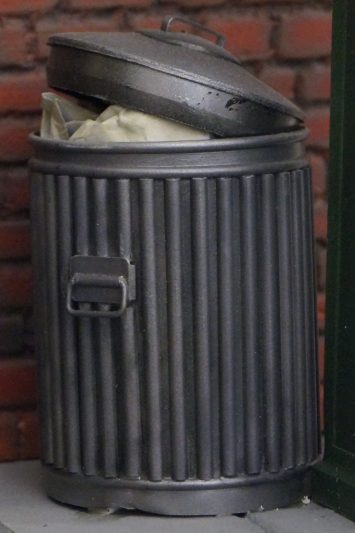
This diorama starts a new category : Comics. I wanted to recreate the cover of one of my favourite comic book : The Yellow ‘M’ frome Edgar P. Jacobs, a Blake and Mortimer adventure. This cover is well fitted for a diorama, it’s almost a 2D one. A huge wall, two characters against the wall and a few accessories : a street light, a basement window and a trash can. Each element has to be made since there is no kits in the market. In this article, I will explain how I made them, on by one.

The brick wall

Foam board for the brick wall in the Yellow 'M' diorama. Blaek and Mortimer.

By Jove !

Cpt. Blake

The wall is representative of the diorama : it cannot be failed. I used a foam board to make it. It’s like polystyren. I found it in an hobby store.

I only engraved the bricks with an engraving tool, softly. The foam is very crumbly and easily workable. It was just a very long work.

Blake and Mortimer - the Yellow 'M' - brick wall

The paint job is quite easy : Tamiya red brown on a black preshadding into the seals. Some bricks are grey-blue colored, as they are on the comic cover. The paint job is hand-maid, with an aerograph.

Making the Yellow ‘M’

The most difficult work in this diorama is the yellow ‘M’ itself. Not easy since I am totally hopeless in drawing art. When art fails, science can manage so I appealed to my basic training : physics. I realized a projection of the yellow markn using a convergent lens.

The aim will be to cut a stencil into a plastic card and then paint the yellow ‘M’ directly threw the stencil.

First, I had to make the objet. That is the “thing” you want to make the image of. I scanned the yellow ‘M’ directly from the comic book, printed it onto a transparency, glued it on a glass slice and finally light it with a powerful lamp :

Blake and Mortimer-the yellow 'M' - the mark to be imaged

A little bit of calculation

Blake and Mortimer -the yellow 'M' - projection apparatus

Then I had to put the elements in place :

  • The lamp
  • The glass slice (with the yellow ‘M’ printed on it)
  • The lens
  • The plastic sheet designed to collect the image and cut out the stencil

In physics, we know how to calculate these positions using the thin lens equation :

Blake et Mortimer la Marque Jaune - ralation de conjugaison
  • x : length between the object and the lens
  • y : length between the lens and the image (plastic sheet)
  • f : focal length of the lens

I needed another data : the magnification. That is the number the objet’s diameter has to be multiplicated to become the image’s diameter.

The object is 3,7 cm in diameter and the image must be 37 cm in diameter. That producez a magnification of… of ??? Hmm ?? 10. Well done.

One interesting feature with the lens equation is that the magnification can apprear in it by the y/x quotient. After a few calculation, you come to this :

Blake et Mortimer la Marque Jaune - formules

The number 10 represent the magnification so if you want onother, just substitute it by your number. These equations give the two positions we need if we know the focal length of the lens. The lens makers give it sometimes but most of the time, you’ll have to measure it by yourself. There are methods for that. Mine has 14,4 cm focal length so the final result is :

  • x = 15,8 cm
  • y = 158,4 cm

We find again the magnification of 10 (y/x) so the reslt is probably the good one. The size of the apparatus is x+y = 1,74 m. The result is the DIY you can see in the picture.

After drawing and cutting out, we obtain this very accurate stencil :

Blake and Mortimer - the yellow 'M' -stencil.

The last move is painting the yellow ‘M’ with an aerograph, firts in white then in yellow (the yellow painting is not covering enough).

The streel lamp

The street lamp took quite a long time to be made. I built it like a kebab around a threaded rod which has the tripl advantage of stiffenning the structure, allowing to screw the elements in addition of gluing them and faciltating the ground fixation :

Blake and Mortimer - the yellow 'M' - street lamp structure.

The red cable brings the light to the top LED, the reversed cuirrent go threw the rod itself (fourth advantage).

The strete lamp elements are scrathced using plastic card, a yellow LED is addes in the top light :

Blake and Mortimer - the yellow 'M' - street lamp light.

The trash can and the basement window

Here again, scrtachbuilt. The trash can has been made from a wrapping cylindre for a postera and styren rods. Teh basement window is sctratched from plastic card and photoecth grid :

The yellow ‘M’ diorama : exhibitions

This diorama is quite new so I showed it only two times :

I didn’t get the enthusiastic reception I expected, very few SF fans knows about Blake and mortimer. I’m getting old, I guess… So bit.

But I had a great pleasure doing this art work which allowed me to escape from my Star Wars mental jail (I got re-cought since). It inspired me others dioramas in the comics world. I’m thinking of making the cover of “Destinatin Moon” from Tintin but that’s another story…

Posted on 1 June 2020 by petersteven in

Battle of Takodana

Resistance strike during the battle of Takodana

Since the first viewing of the movie, this battle of Takodana scene have alerted my model maker’s sixth sense. Quite annoying by the way. Everey time I watch a SF or war movie, I have hard time to go into the story itself. My mind can’t resist analyzing decors and vehicules ; I always wonder how I could kitbash this, scratch that… Don’t make the same mistake as me, don’t go into modeling, modeling is the devil. Just place an order instead, so you will keep a peacefull mind 🙂 . Anyway, this scene awoke (the Force) my diorama desire, and that’s a good thing.

A medieval castle in Star Wars ?

construire le moyen âge

I found it weird too, on the first time. But after all, every one wanted newness, here it is. In Star Wars, we already had western, epic, space opera, why not a stone castle ? It might have at least inspired me.

A couple of years ago, someone gave me parts from a collection “Buil the middle-age”. I had many sachets full of real small stones which would fit very well in this diorama. The stones were correctly glued and painted to look like Maz’s ruined castle. And this was very cheap as it was recycling.

Water…

Making water in a diorama is a recurrent problem. I wanted to do so to feature the lake next to which the battle of Takodana occurs. By the way, some people see in that scene a reminder of the Arthurian legend : Maz Kanata is the Lady of the Lake giving the magic sword (Excalibur – Luke’s lightsaber) to the unknown hero (Arthur – Rey). I like this way of viewing.

So, I had to make realistic water. Many techniques can be used to do so. My favourite is the inclusion resin you can find in DIY stores. The resin is usally used to make very nice stuff like bookend with pretty flower included. Once the resin is polymerized (and not “dry”), wich takes a few days, I covered it with medium acrylic. The medium becomes totally transparent when drying and allows to “sculpt” the water surface.

Muddy soil

The scene features a ravaged soil, the ground is turned like a WW1 no-man’s land. To make this, I used a preparation including water, white glue and sawdust. The preparation is distempered on the all surface. Once it’s dry and painted with several shade of brown, the “burnt soil” effect is quite convincing.

The ships involved in the battle of Takodana

brins d'acier collés sur Tie écrasé

In addition to the resistance T70 X-Wings, I had to feature the First Order. Instead of a flying Tie fighter which would have made the scene too heavy, I decided to crush one on the floor. I never enjoy destroying a model (well in fact, maybe I do somehow…). I always hesitate a bit… and then I go frankly.

The most difficult part was to glue one by one all the tiny steel wires to simulate the solar panel torn by laser blasts and the ground crash. How many time spent my eyes fixed on my binocular magnifier… On day, if you are nice guys, I’ll show you my face with my magnifier… And one wonders why model makers can’t get a girl… The fuel leak is made with the same resin I used for the water, green-yellow colored.

Battle of Takodana exhibitions

I exposed this diorama three times :

I’m not done with episode VII, I intend to realize the Poe Dameron and Finn’ escape onboard a Spec Force Tie Fighter (the one with the red pattern) but it’s another story…

Posted on 9 March 2018 by petersteven in

Sullust

Rebel fleet over Sullust - Battle of Endor

This “Sullust” diorama has been in my mind for a long time. I often say that to introduce a subject because I find that very class. Like I was a “tortured artist” or somehing like that… Sullust, so, why this title ? I like very well mysterious titles. For example, my ther big diorama, the “Trench run” was first called “Year zero”. But try to make google understand such a subtle title ! So I had to choose a more SEO compatible to get some people on the website.

Sullust, such a mysterious title mmhh…

Sullust, because it’s the planet name around which the rebel fleet gathers just before jumping into hyperspace to Endor. And because search engines find it easily. This diorama took two years of my beautiful youth to be made. I had to make almost 30 models, at multiple scales. Some were made very fast but some of theme took over two months like the Blockade Runner. Here is a complete list od the models (click on a model name to go to the relevant page) :

  1. B-Wing “cruciform fighter” from BlueMoon 1:48
  2. A-Wing fighter from MPC 1:48
  3. X-Wing fighter from Finemolds 1:72 (x2)
  4. Y-Wing fighter from Finemolds 1:72
  5. GR-75 Medium Transport from Anigrand 1:144
  6. Y-Wing from F-Toys 1:144 (x3)
  7. X-Wing from F-Toys 1:144
  8. B-Wing from F-Toys 1:144
  9. Blockade Runner “Rebel Runner” de Bluemoon 1:350
  10. X-Wing Fantasy Flight 1:350 (x3)
  11. B-Wing Fantasy Flight 1:350 (x2)
  12. Y-Wing Fantasy Flight 1:350
  13. A-Wing Fantasy Flight 1:350
  14. Croiseur Mon Calamari from Anigrand 1:2256
  15. Frégate Nebulon-B from Angrand (x2)
  16. GR-75 Medium Transport from Anigrand 1/2256 (x4)
  17. Blockade Runner from Anigrand 1/2256 (x2)

You can count 28 models in this diorama. Not to mention the dozens of tiny 1:2256 starfighters included in the hangar of the Liberty. It’s a personnal record.

Sullust, a perspective matter

This diorama presents a particular feature which won’t escape your notice, it’s made at 5 different scales. I could’nt do otherwise to get a complete fleet. How to represent small 10 meters in length starfighters beside 1 km in length cruisers ? Of course I could have scratched 5 mm X-Wings (I did it by the way) but this would not have been fair, given the beauty of the X-Wing ships. The idea was to make several blocks at small scale (1/48, 1/72) and others at big to huge scale (1/2256). Then I aligned the blocks in such a way that an observer watching the diorama from behind would see a perspective effect, as it was made in the movie. I hope I have succeeded.

The decor : stars, stars and more stars

I wanted a stary sky for my fleet. I could have sprayed some white painting on a black surface with a tooth brush for example. It may have worked but the luminosity wouldn’t have been high enough. I chose the fiber optic slution, a very well known technique. I had to put thousands of fibers in 0.5 mm holes everywhere. I think this was the most time-eater in this diorama.

To do that, I begin to tape a harness of fibers on a LED and I glue them one by one in the holes using white glue. I wanted a colored, not sad diorama like an imperial one would have been. That’s why I used warm white, cool white and gold white DELs for the stars and not the same white for all the stars.

Finding models in unexpected places

To do the 1:350 block, I used many starfighters miniatures from the “X-Wing miniature game” edited by Fantasy Flight. This game (very good by the way) provides almost every ships seen in the Star Wars movies at 1:350 scale. Of course I repainted them. However, the real challenge was the light up. For the Y-Wing, no problem, the LEDs fit in the thrusters pretty well. Others like the X-Wing have been drilled and optical fibers been put in. The LED is fited at the base of the support rod.

Expositions

This diorama has been exposed entirely only two times :

However, as its assembly took two years, I had the opportunity to show the first three blocks 3 or 4 times before I completed the entire scene. I intend to make a “nemesis” to this diorama : an entire imperial fleet based on the same concept. I will make an imperial stardestroyer, the superstardestroyer Executor, the Death Star II and a lot of Tie fighters. But that is another matter which will take a few years of my life…

Posted on 23 January 2018 by petersteven in